Calculating
Who invented the calculator? From the abacus to the Dutch zakjapanner
Written for readers in the Netherlands
Who built the first calculator, and why people in the Netherlands call a pocket calculator a zakjapanner.

Photo: Rama / Wikimedia Commons (opens in a new tab), CC BY-SA 3.0 FR (opens in a new tab), edited
Not long after the Second World War, two men sat down in Tokyo for an arithmetic contest. One was an American soldier with an electric calculator. The other was a Japanese postal worker with a soroban, the Japanese abacus. Both knew their device inside out. The abacus won, even though on an abacus you do the thinking yourself. The beads only hold the numbers, and the sums happen in your head. How a machine took that work off our hands, one piece at a time, is the history of the calculator. The calculator has no single inventor, and in the Netherlands the one in your pocket even has a nickname that points to Japan.
In November 1946, Kiyoshi Matsuzaki and his soroban beat Private Thomas Nathan Wood in four of the five rounds.
Early abacuses were probably stones laid on lines in the dirt. The word calculate goes back to them. In Latin, a calculus was a pebble on a counting board.
The first calculators with gears
One bit of thinking the gears took over was carrying the one. On paper or on an abacus, you keep track of it yourself. In a calculator with gears, a wheel that turns from 9 to 0 nudges the next wheel along by one.
Wilhelm Schickard described such a machine in 1623, in a letter to the astronomer Johannes Kepler. It could add, subtract, multiply and divide. The copy meant for Kepler burnt before it was finished. We know it only from his letters to Kepler and a sketch that surfaced among Kepler's papers in the 20th century. A replica built from that sketch worked.
Blaise Pascal was still a teenager when he came up with his calculator in 1642. His father was a tax official in Normandy, and Pascal wanted to lighten his workload. He never sold many, but nine still exist.
So the question of who invented the calculator has two answers. Schickard's machine is the earliest known, though only on paper. Pascal's machines are the oldest surviving mechanical calculators.
Calculators with keys and a motor
In the 19th century, the arithmometer of Thomas de Colmar turned the calculator into a factory product. Using one still took effort. Some machines had a crank, and if you turned it too fast, the answer could come out wrong.
The Comptometer had no crank, because pressing the keys drove the mechanism. Dorr Felt patented it in 1887, after building his first model in a macaroni box.
By the 1920s, many calculators were motorised. You still keyed in every step yourself. In Tokyo, the electric calculator lost to the abacus.
Electronic calculators
An electronic calculator has no gears, only current running through circuits. The first one you could buy for your desk, ANITA, was announced in 1961 by the British firm Bell Punch.
Chips let calculators shrink. At Texas Instruments in 1967, the chip pioneer Jack Kilby designed the first hand-held calculator that could do all four basic operations. It had no screen. The answer came out on a little strip of paper.
The calculator in your pocket
The palm-sized Casio Mini went on sale in 1972 and put a pocket calculator within everyone's reach. More than a million were sold in its first year.
Engineers at the time still worked with a slide rule, two bars marked with scales that slide past each other. How accurate it was depended on the person using it. A pocket calculator from Hewlett-Packard, also from 1972, could do everything a slide rule could, to ten digits. That model and the ones that followed replaced the slide rule. The skill of the person doing the sums, which had decided the contest in Tokyo, was no longer what made the difference.
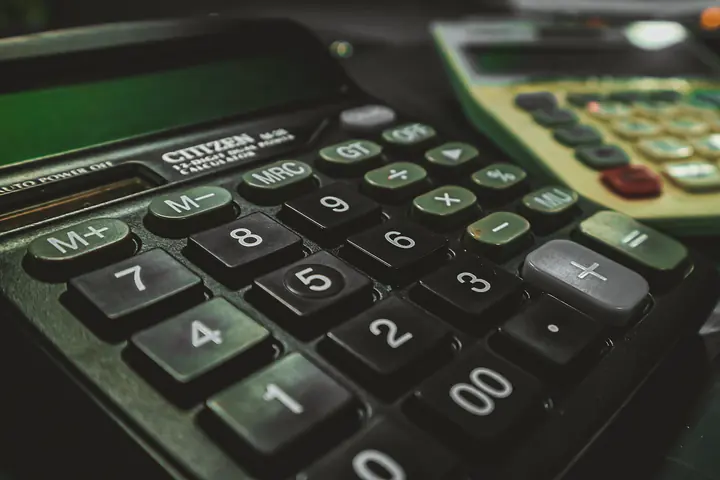
Casio is a Japanese brand. The ordinary Dutch word for a calculator is rekenmachine. A Japanner is a Japanese person, but in everyday Dutch a japanner can also be something made in Japan, such as a car or a calculator. A pocket calculator is informally a zakjapanner, a Japanese one for your zak, or pocket.
Dutch uses the word calculator too. There it first meant a person who did the sums, and only later the device. Today the calculator is on your phone, or in the calculator on Sumish. It puts every step on a paper roll, a bit like Kilby's strip of paper, so you can check your working.
Consulted on 8 November 2026. Sources marked (in Dutch) or (in German) are not available in English.
- The Versatile, Venerable Abacus | Computer History Museum (opens in a new tab)
- Soroban or abacus, 20th century | Whipple Museum of the History of Science (opens in a new tab)
- calculeren | Etymologiebank (opens in a new tab) (in Dutch)
- Schickards Rechenmaschine | University of Tübingen (opens in a new tab) (in German)
- Schickard's Calculator and The Pascaline | Computer History Museum (opens in a new tab)
- Blaise Pascal's calculating machine | Arithmeum, University of Bonn (opens in a new tab)
- Pascal's Arithmetic Machine, later known as the Pascaline | Musée des arts et métiers, Google Arts & Culture (opens in a new tab)
- Mass-Produced Calculators | Computer History Museum (opens in a new tab)
- Introducing the Keyboard | Computer History Museum (opens in a new tab)
- Answers in Black and White (And Sometimes Right) | Computer History Museum (opens in a new tab)
- Electronic Calculators | Computer History Museum (opens in a new tab)
- From Desktops to Handhelds | Computer History Museum (opens in a new tab)
- Casio Mini | IPSJ Computer Museum (opens in a new tab)
- Slide Rules | Computer History Museum (opens in a new tab)
- Milestones: Development of the HP-35, the First Handheld Scientific Calculator, 1972 | IEEE (opens in a new tab)
- Japanner | Algemeen Nederlands Woordenboek, Dutch Language Institute (opens in a new tab) (in Dutch)
- zakjapanner | Etymologiebank (opens in a new tab) (in Dutch)
- calculator | Etymologiebank (opens in a new tab) (in Dutch)