Units
Where does the metre come from? The old ell and rod in the Netherlands
How the metre was measured from the Earth, and how long the old Dutch ell and rod were before the metre replaced them.

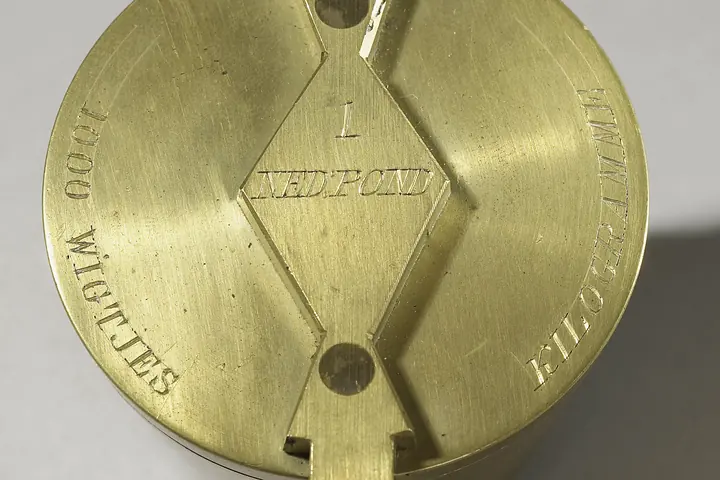
Photo: Rijksmuseum / Wikimedia Commons (opens in a new tab), CC0 (opens in a new tab), edited
Pull out a tape measure and you're looking at a unit that was meant to come from the Earth itself. While Paris was working on it, the Netherlands still measured in ells that changed from one town to the next. The new unit couldn't depend on someone's forearm or on local habit, because everyone, everywhere, had to be able to make it again. Two Dutchmen sat on the commission that fixed it.
A measure of the Earth
In 1790, in the middle of the Revolution, the French Academy of Sciences was given the job of bringing all weights and measures into line. The new unit was meant for all people and for all time. A measure taken from the Earth would last as long as the Earth did.
So the metre became one ten-millionth of the distance from the North Pole to the equator. Nobody could measure all of that. Instead, one stretch was measured, from Dunkirk through Paris to Barcelona, and the rest was worked out.
The astronomers Jean-Baptiste Delambre and Pierre Méchain set off in the summer the Tuileries Palace in Paris was stormed. They measured with triangles. Know one side of a triangle and its angles, and you can work out the other sides. They needed more than ninety triangles and seven years.
To get Parisians used to the new unit, sixteen marble metres were put up in busy spots. One is still in its original place, on the rue de Vaugirard. The metre's length went into French law in 1799, and a platinum metre into the national archives in Paris.
Ells and rods that differed by town
In the Netherlands, you bought cloth by the el, or ell, a measure that goes back to the forearm. An old Dutch ell was about 69 centimetres, depending on the town. In 1564, Amsterdam ruled in its city ordinance that traders who sold by the ell had to use one that matched the city's measure, "no longer and no shorter".
Land surveyors worked with the roede, or rod, which was a set number of voet (feet). The Rhineland rod, from the area around Leiden, was 12 feet and was used to measure land across much of the Netherlands. Other places had a rod and a foot of their own. A foot was made up of duim, literally thumbs, the old Dutch inch.
| Old unit | In metres |
|---|---|
| Rhineland foot (Rijnlandse voet) | 0.314 |
| Amsterdam foot | 0.283 |
| Rhineland rod (Rijnlandse roede) | 3.767 |
| Amsterdam rod (13 feet) | 3.677 |
| Amsterdam ell | 0.688 |
| Hague ell | 0.694 |
Your own town's old units are in the Meertens Institute's database (opens in a new tab) (in Dutch).
From ell to metre
Two Dutch professors, J.H. van Swinden and H. Aeneae, sat on the French commission that set up the metric system. They represented the Batavian Republic, the Netherlands of that time, and brought examples of the new units home. A one-metre measuring rod in the Rijksmuseum (opens in a new tab) may be one of them.
King William I made the metre compulsory in 1820. Prefixes like kilo and centi were still a step too far, so the metre was given an old name, the Dutch ell (Nederlandse el). It was almost one and a half times as long as the Amsterdam ell.
As the standard for the new ell, the Netherlands got its own platinum metre, which a royal decree named the "only standard of the Dutch ell". The copper plate that came with the bar, in the photo at the top, also says how accurate the bar was: seven ten-thousandths of a millimetre shorter than the metre in the national archives in Paris.
The Dutch ell was officially renamed the metre in 1870. The cloth trade kept measuring in old ells into the 20th century, and in the end a law banned the old names. For the pound, see why a Dutch pound is 500 grams.
How the metre is defined today
For a long time the metre was a platinum bar, and the last one had iridium in it. Since 1983 it has been defined by light: a metre is the distance light travels in empty space in 1/299,792,458 of a second.
The inch is fixed in metres too. After a 1958 agreement between English-speaking countries, an inch is exactly 2.54 centimetres. That makes a mile exactly 1.609344 kilometres. You can convert miles and inches with the length converter.
Example: 1 mile in kilometres
Result
1.609344 km
Length 1 · miles · kilometres
Consulted on 8 November 2026. Sources marked (in Dutch) or (in French) are not available in English.
- The International System of Units (SI Brochure), 9th edition 2019, updated 2026 | BIPM (opens in a new tab)
- SI Units: Length | NIST, the US National Institute of Standards and Technology (opens in a new tab)
- Weights and Measures Act 1985, Schedule 1 | legislation.gov.uk (opens in a new tab)
- Deux mètres, a one-metre measuring rod from around 1800 | Rijksmuseum (opens in a new tab)
- Copper plate from the platinum standard metre of 1839 | Rijksmuseum (opens in a new tab) (in Dutch)
- The Statesman's Year-Book 1871, Netherlands: weights and measures | Wikisource (opens in a new tab)
- Le mètre : mesure républicaine (10 October 2014) | Observatoire de Paris (opens in a new tab) (in French)
- Le mètre étalon de la place Vendôme restauré et réinstallé (6 May 2021) | Ministère de la Justice (opens in a new tab) (in French)
- El | Woordenboek der Nederlandsche Taal (1917), Dutch Language Institute (opens in a new tab) (in Dutch)
- lengtemaat: voet | Maten en gewichten, Meertens Instituut (opens in a new tab) (in Dutch)
- lengtemaat: roede | Maten en gewichten, Meertens Instituut (opens in a new tab) (in Dutch)
- lengtemaat: el | Maten en gewichten, Meertens Instituut (opens in a new tab) (in Dutch)
- Inventaris van het archief van het IJkkantoor te 's-Gravenhage | Nationaal Archief (opens in a new tab) (in Dutch)
- Hans van Maanen, Een kilo prei: het succes van het metrieke stelsel (Onze Taal, 1995) | DBNL (opens in a new tab) (in Dutch)