Units
Ons and pond: why a Dutch pound is 500 grams
You'll hear ons and pond at every Dutch butcher's. Where these old weights come from, and why the price sign says 100 grams, not an ons.

Photo: Rijksmuseum / Wikimedia Commons (opens in a new tab), CC0 (opens in a new tab)
At a butcher's in the Netherlands, people ask for een pond gehakt, a pond of mince. At the cheese counter they want twee ons belegen, two ons of matured cheese. Nobody bats an eye. The sign in the display case shows kilos and grams, though, because ons and pond stopped being official units long ago. Yet they never left the shop. And the pond changed its weight more than once before it settled at the counter.
The pound differed from town to town
Pond is the Dutch word for pound, and a very old one. It goes back to the Latin pondo, "by weight", from pondus, weight. How much a pond weighed depended on where you lived.
In Amsterdam, the pound of the city weigh house was 494 grams, divided into sixteen ons. So an ons back then was a good deal lighter than today's. Rotterdam had a light pound of 469 grams. Even a single town could have more than one pound. Amsterdam weighed medicines with a much lighter pound than goods for sale. For many places, you can look up the old pound in the Meertens Institute's database (opens in a new tab) (in Dutch).
The Dutch pond weighed a kilo
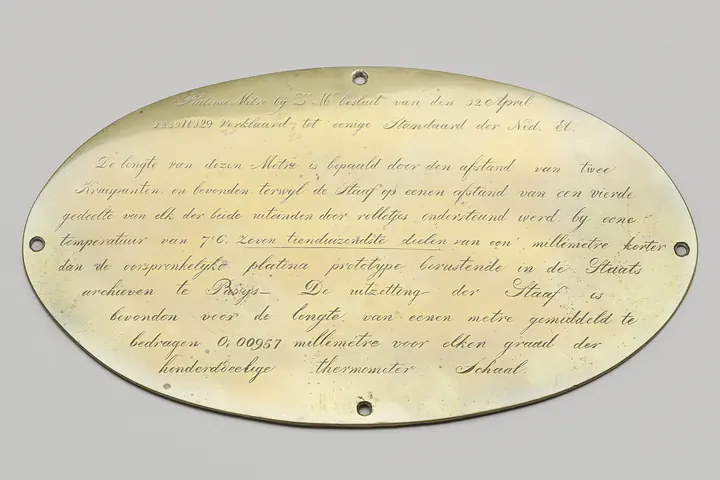
For weights, the metric system came down to a new unit with an old name. The law that brought it in started from pure water in a cube of ten by ten by ten centimetres. That holds a litre, and a litre of water weighs a kilo. This weight "zal den naam van pond dragen", the law said: it shall bear the name of pond.
So the Dutch pond became a kilogram, about two old Amsterdam pounds. In the photo at the top, the weight carries both names, Ned. Pond and Kilogramme. You can read how the Netherlands switched to the metric system in our article on the metre.
This new pond was split into tenths, and each tenth was called an ons. That put the ons at 100 grams, more than three times the old Amsterdam ons. It's the same ons you ask for today. The pond went a different way.
How the pond became half a kilo
The pond of a kilo didn't last. In 1935, the big historical dictionary of Dutch called that meaning all but out of use. By then it also knew the pond of today. In the Netherlands, it said, pond now meant a weight of 500 grams.
While the ons stayed where it was, the name pond moved to half a kilo. So een half pond gehakt is 250 grams of mince. None of the dictionaries we checked says why it was half a kilo in particular. Half a kilo was close, though, to most of the old pounds from before the metric system.
Ons and pond on the price sign
In the Netherlands, the legal unit of weight is the kilogram. That's why a shop may not offer an ons of sliced meat, the Dutch government writes, though it may offer 100 grams.
Meat and cheese that the butcher or cheesemonger weighs out for you are priced per kilo or per 100 grams. Ons may appear next to that, as long as it doesn't stand out more than the grams. At the counter, people still just say ons.
The pound (lb) is lighter than a pond
Recipes written in English use pounds too, but that's a different unit. A pound (lb) weighs about 454 grams.
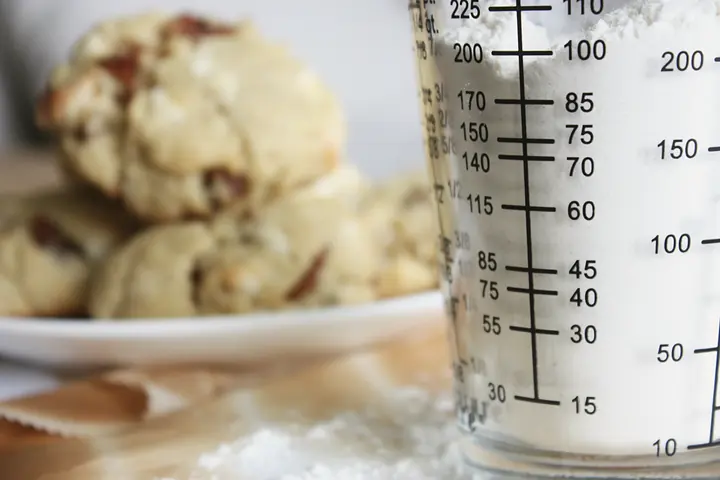
A pound has sixteen ounces, just as the old Amsterdam pound had sixteen ons. One ounce (oz) weighs about 28 grams. The fluid ounce in the same recipe isn't a weight but a measure of volume.
If a recipe calls for 1 lb of mince, ask the butcher for just over four and a half ons. For other amounts, the weight converter has ons and pond alongside grams, kilos, ounces and pounds.
Example: 1 pound (lb) in ons
Result
4.5359 ons
Weight 1 · pounds (lb) · ons (100 g, Dutch)
Consulted on 8 November 2026. Sources marked (in Dutch) are not available in English.
- Weights and Measures Act 1985, Schedule 1, Part VI | legislation.gov.uk (opens in a new tab)
- gewicht: pond | Maten en gewichten, Meertens Instituut (opens in a new tab) (in Dutch)
- gewicht: ons | Maten en gewichten, Meertens Instituut (opens in a new tab) (in Dutch)
- pond | Etymologiebank, Etymologisch Woordenboek van het Nederlands (opens in a new tab) (in Dutch)
- ons | Etymologiebank, Etymologisch Woordenboek van het Nederlands (opens in a new tab) (in Dutch)
- Pond (1935) | Woordenboek der Nederlandsche Taal, Instituut voor de Nederlandse Taal (opens in a new tab) (in Dutch)
- Hans van Maanen, Een kilo prei: het succes van het metrieke stelsel (Onze Taal, jaargang 64, 1995) | DBNL (opens in a new tab) (in Dutch)
- Metrologie: betrouwbaar meten | Rijksoverheid (opens in a new tab) (in Dutch)
- Metrologiewet, artikel 22 | wetten.overheid.nl (opens in a new tab) (in Dutch)
- Regeling vrijstellingen Metrologiewet, artikel 1 | wetten.overheid.nl (opens in a new tab) (in Dutch)
- Besluit prijsaanduiding producten, artikelen 1 tot en met 3 | wetten.overheid.nl (opens in a new tab) (in Dutch)