Energy
Home battery in the Netherlands: when does it pay for itself?
Written for readers in the Netherlands
With net metering ending in the Netherlands, is a home battery worth it? We work out whether it pays for itself in a Dutch home before it wears out.

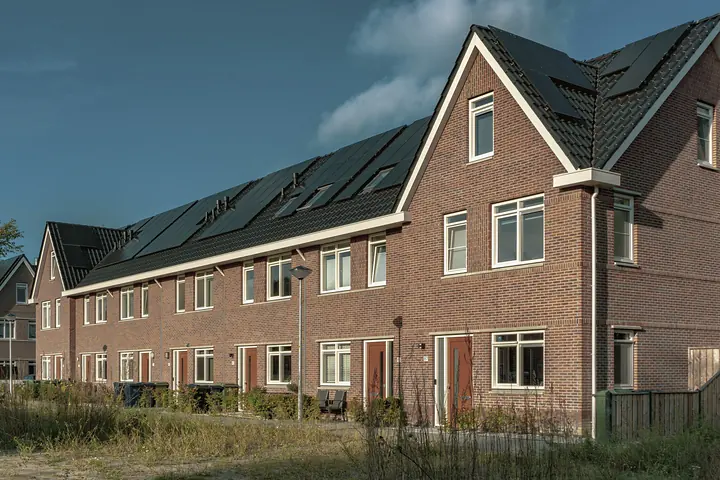
Photo: Ampltsemi3 / Wikimedia Commons (opens in a new tab), CC BY 4.0 (opens in a new tab), edited
It's a sunny Tuesday afternoon in the Netherlands, nobody's home and the solar panels on your roof are running flat out. The power disappears onto the grid. In the evening the oven goes on and you draw power back. For now, your supplier offsets the one against the other under the Dutch net metering scheme (salderingsregeling). That stops on 1 January 2027, and in many Dutch homes with solar panels the next thought comes easily. Put a home battery (thuisbatterij) in between and keep your own power for the evening.
That thought is right, for one kilowatt-hour. So we'll follow one, from your roof to your oven, with Dutch prices and Dutch rules. Then we'll count how many of them a battery moves in its lifetime, because that decides whether it pays for itself. You can enter your own figures straight away in Home Battery in the Netherlands: Does It Pay for Itself?
What one kilowatt-hour is worth
The first route is the shortest: onto the grid. On a fixed or variable contract, most Dutch suppliers leave you with around 1.25 cents after feed-in costs (terugleverkosten), according to the Dutch information centre Kenniscentrum Duurzaam Leven, formerly Milieu Centraal (October 2026).
The second route goes through the battery, which loses part of it. CE Delft, a Dutch research firm, puts the loss from charging and discharging at about 15%. What's left is power you don't have to buy that evening, and the centre puts the expected average Dutch electricity price at 21 cents.
That comes to nearly 18 cents against just over 1 cent. The gain only exists once net metering has gone, because while you can still offset, power on the grid is worth as much as power from the battery.
If your contract runs past 1 January 2027, check what it says. According to the Dutch consumer and markets authority ACM (Autoriteit Consument & Markt), you may still have a right to net metering, and that kilowatt-hour then brings in less until the contract ends.
How many kilowatt-hours a battery moves
That difference, just over 16 cents per kilowatt-hour that goes in, has to pay for a whole battery. According to CE Delft, a small one started at € 3,500 in the Netherlands in January 2026, with VAT (btw) and installation.
So a little over 21,000 kilowatt-hours have to go through it before it breaks even. Full every day and empty every evening would help, but solar panels don't deliver that. On an average June day in the Netherlands, ten panels produce three times what fits in it. On an average December day, half. In summer the rest goes onto the grid anyway, and in winter it doesn't come close to full.
On average, it doesn't even fill completely once a day. At that pace, those 21,000 take more than sixteen years, and that's before the yearly costs.
Example: ten panels and a 5 kWh battery
Paid back after
20 years and 4 months
Battery size (kWh) 5 · Purchase price with VAT and installation €3,500 · Electricity price per kWh €0.21 · Full charge cycles per day 0.7 · Costs per year €40
Saving per year
€172.07
Saving minus purchase price
-€919
Saving over the lifespan
€2,581
Extra solar power used from the battery
1,086 kWh per year
Stored instead of fed back
1,278 kWh per year
Solar power that does not go to the grid, with a battery
64 %
Only after 20 years and 4 months has the battery paid for itself.
CE Delft expects a lifespan of 10 to 15 years, though few batteries have run that long yet. So it wears out before it has paid for itself.
The centre keeps it short: right now, a battery in a Dutch home will most probably not pay for itself. CE Delft estimates 10 to 22 years for one this size, using the higher electricity prices from its study.
A larger battery
A bigger battery seems the natural next step. In the tool, it costs € 2,500 more and saves 29 cents more a year. That isn't exact to the cent, but it stays small.
Your panels produce the same amount. There's room for more kilowatt-hours, but they aren't there, and the big battery costs more to run.
Twice the size: 10 kWh for € 6,000
Paid back after
34 years and 10 months
Battery size (kWh) 10 · Purchase price with VAT and installation €6,000 · Full charge cycles per day 0.4 · Costs per year €70
Saving per year
€172.36
Saving minus purchase price
-€3,415
Saving over the lifespan
€2,585
Extra solar power used from the battery
1,241 kWh per year
Stored instead of fed back
1,460 kWh per year
Solar power that does not go to the grid, with a battery
68 %
Electricity price, subsidy and contract
That one kilowatt-hour could become worth more, or the battery cheaper. This is the same example, with one thing different each time.
| What's different | Paid back after |
|---|---|
| Electricity at 27 cents (Dutch price, January 2026) | 14 years and 9 months |
| Completely full and empty every day | 13 years and 4 months |
| Paying a net 4 cents for feed-in | 14 years and 8 months |
| € 5,000 purchase price (top of CE Delft's range) | 29 years and 1 month |
Even the best row stays above thirteen years, so the battery then really has to last.
Nobody knows what electricity will cost in the Netherlands in ten years. The 21 cents is an expectation, not today's price.
Full every day is the upper limit in the tool, and in winter a battery doesn't come close. A home with very high use and plenty of panels did clearly better in CE Delft's study.
A contract with feed-in costs helps the battery. If the route onto the grid costs you money, every kilowatt-hour in the battery saves that charge. A few small Dutch suppliers make you pay for what you feed back.
There's no national Dutch subsidy, the centre writes. A few municipalities (gemeenten) and provinces (provincies) have their own schemes, with limited budgets. According to the Dutch Tax Administration (Belastingdienst), you only get the VAT back if you also buy and sell electricity with the battery, and our tool doesn't calculate that trading. The centre expects batteries to get cheaper. Under Dutch rules, a battery of 0.8 kW or more has to be registered at Energieleveren.nl, a Dutch-language site.
Since 1 November, a number of suppliers in the provinces of Gelderland, Utrecht, Flevoland and Noord-Brabant also pay you if your battery helps to absorb peaks on the electricity grid, the Dutch government says. The rest of the Netherlands follows next year. The government doesn't mention an amount, and the tool doesn't include it.
It doesn't have to be about money. Once net metering ends, your bill goes up anyway, CE Delft concludes, battery or not. The centre calls a battery an option if you want to be somewhat less dependent on the grid, or see it as a fun but expensive gadget. According to the centre, it's no use in a power cut without a special backup function.
Using your own power directly
There's a third route. That kilowatt-hour can go straight into the washing machine at the sunniest moment. You lose nothing and there's nothing to buy. There isn't much scope, though. With the dishwasher, washing machine and tumble dryer on solar power, the centre's figures for a Dutch household go from an average of 30% own use to 35%.
And the battery? Put your quote into the tool. If the size isn't 5 kWh, change the full charge cycles and the costs per year too. Anything else you don't know can stay as it is.
Consulted on 13 November 2026. The charge cycles and costs per year on the cards come from the model by CE Delft and Witteveen+Bos (2023), the battery prices and lifespan from CE Delft (January 2026).
- ACM's Monitor on the consumer energy market: suppliers must inform customers properly about important changes in 2027 (17 October 2025) | ACM (opens in a new tab)
- ACM: feed-in costs for solar power are not unreasonable, though contracts are difficult to compare (17 December 2025) | ACM (opens in a new tab)
- Salderen en terugleveren (in Dutch) | ACM (opens in a new tab)
- Overheid en energiesector spreken doel en acties af voor meer grote batterijen in Nederland, 9 November 2026 (in Dutch) | Rijksoverheid (opens in a new tab)
- Salderingsregeling stopt in 2027 (in Dutch) | Rijksoverheid (opens in a new tab)
- Thuisbatterij: zonne-energie opslaan, last changed 9 November 2026 (in Dutch) | Kenniscentrum Duurzaam Leven, formerly Milieu Centraal (opens in a new tab)
- Zonnestroom zonder saldering, last changed 30 October 2026 (in Dutch) | Kenniscentrum Duurzaam Leven, formerly Milieu Centraal (opens in a new tab)
- Prijs en opbrengst zonnepanelen, last changed 5 November 2026 (in Dutch) | Kenniscentrum Duurzaam Leven, formerly Milieu Centraal (opens in a new tab)
- Besparingen: met welke energieprijzen rekenen we?, last changed 24 June 2026 (in Dutch) | Kenniscentrum Duurzaam Leven, formerly Milieu Centraal (opens in a new tab)
- Thuisbatterij en btw (in Dutch) | Belastingdienst (opens in a new tab)
- Registreer uw batterijsysteem, checked 17 August 2026 (in Dutch) | RVO (opens in a new tab)
- Verordening Duurzaamheidssubsidie Noordwijk 2026 (in Dutch) | Gemeenteblad (opens in a new tab)
- Nadere regels Subsidie Thuisbatterij Provincie Flevoland (in Dutch) | Lokale wet- en regelgeving (opens in a new tab)
- Thuis- en buurtbatterijen, CE Delft and Witteveen+Bos, December 2023, for the Ministry of Economic Affairs and Climate (in Dutch) | Officiële bekendmakingen (opens in a new tab)
- Proefopstellingen thuisbatterijen, January 2026, for Vereniging Eigen Huis (in Dutch) | CE Delft (opens in a new tab)