Roman numerals converter
Convert a number to Roman numerals or Roman numerals back to a number, from 1 to 3999, with how it is built per place and the rules.
This tool applies Dutch rules. Text translated from Dutch; the Dutch version prevails. Open the Dutch version
2026 in Roman numerals
MMXXVI
MMXXVI = MM + XX + VI
| 2000 | MM |
|---|---|
| 20 | XX |
| 6 | VI |
| Together 2026 | MMXXVI |
| I | 1 |
|---|---|
| V | 5 |
| X | 10 |
| L | 50 |
| C | 100 |
| D | 500 |
| M | 1000 |
When a smaller symbol stands before a larger one, you subtract it: IV is 4, IX is 9, XL is 40, XC is 90, CD is 400 and CM is 900. Otherwise you add everything up, and in the standard form the same symbol appears at most three times in a row.
Keep going
Last reviewed:
Please note: The result is an estimate and has been rounded. Actual costs and values may differ, and no rights can be derived from this calculation.
How it works
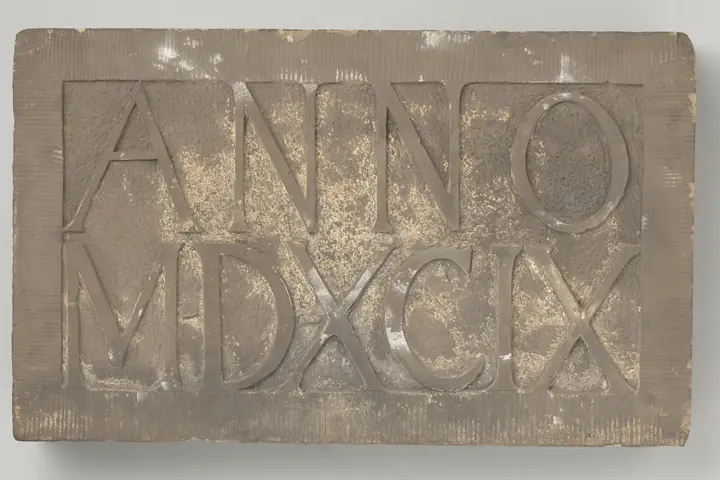
What is 2026 in Roman numerals, and which year is carved in that facade? Type a number or Roman numerals and see the other side at once. Below it you see how the number is built, per thousands, hundreds, tens and units.
You still come across Roman numerals often: on buildings and gravestones, in the years of films, with kings and popes (William III), on clock faces and in chapter numbers.
There are seven symbols: I is 1, V is 5, X is 10, L is 50, C is 100, D is 500 and M is 1000. You add them up from left to right. When a smaller symbol stands before a larger one, you subtract it. In the standard form that only happens in six pairs: IV (4), IX (9), XL (40), XC (90), CD (400) and CM (900).
We convert per place. 1994 is 1000 + 900 + 90 + 4, so M + CM + XC + IV = MCMXCIV. The other way round we read the symbols and check that the number really is written that way. That is why IIII for 4 or IC for 99 is not accepted.
Frequently asked questions
What is 2026 in Roman numerals?
MMXXVI: M twice (2000), X twice (20) and VI (6).
What is the largest number in Roman numerals?
With the standard symbols it is 3999, MMMCMXCIX. For larger numbers the Romans put a bar over a symbol, making it count a thousand times as much.
What this tool leaves out
- Only numbers from 1 to 3999. For larger numbers the Romans drew a bar over a symbol (a thousand times as much); that is not included.
- The Romans had no numeral for zero. They wrote fractions in twelfths, with S for a half and a dot for each twelfth; the tool does not convert those.
- We follow the standard form. Old buildings and clock faces sometimes show IIII for 4; the tool does not accept that form.
Sources and checks
Changes
- : First version.
Last reviewed: · How we build and check our tools
More tools
- Word counterCount the words, characters with and without spaces, sentences and paragraphs of a text. Your text stays in your browser and goes nowhere.
- Average Calculator: Mean, Median and ModeWork out the mean, median and mode of a list of numbers, plus the sum, range and standard deviation, all at once and with an explanation of each result.
- CalculatorA plain online calculator: add, subtract, multiply and divide, with percentages, square root and memory. Your sums go on a paper roll next to it, and you can use your keyboard too.